
The original MechWarrior (1989), reverse engineered and rebuilt as modern C++, every step checked against the original’s own logic. It began from Elthial’s MechWarrior SDL port, credited in its repository, and has since been reverse engineered and rebuilt well beyond it. MW1 Rebuild for short. The BattleTech launcher downloads MechWarrior (1989)’s original files for you, or it uses your own copy.
Screenshots
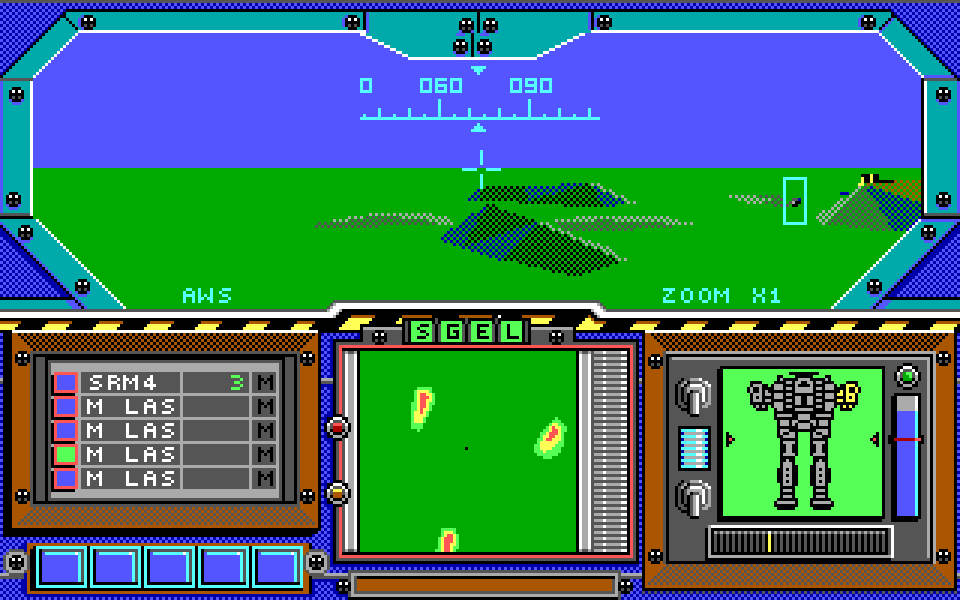
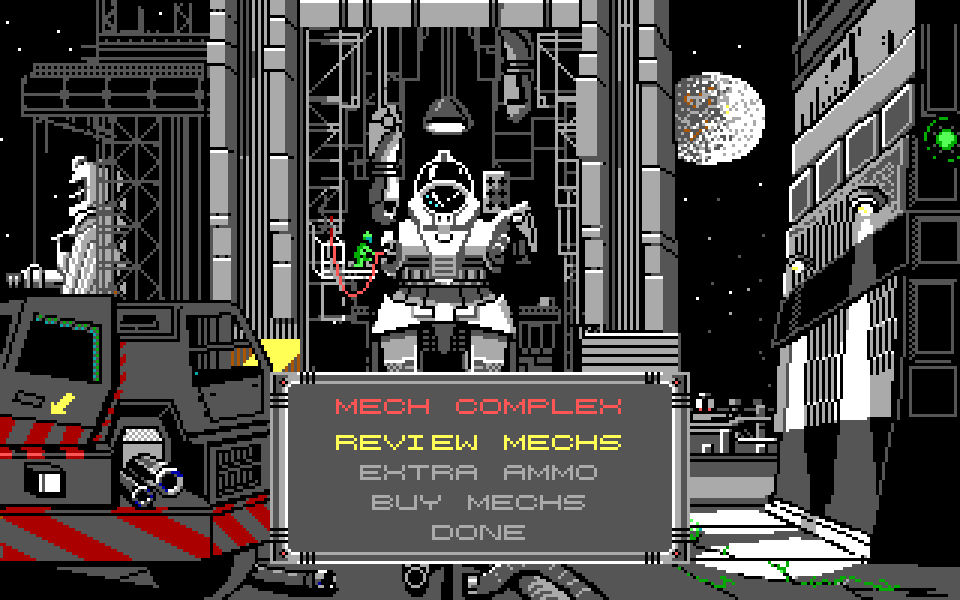
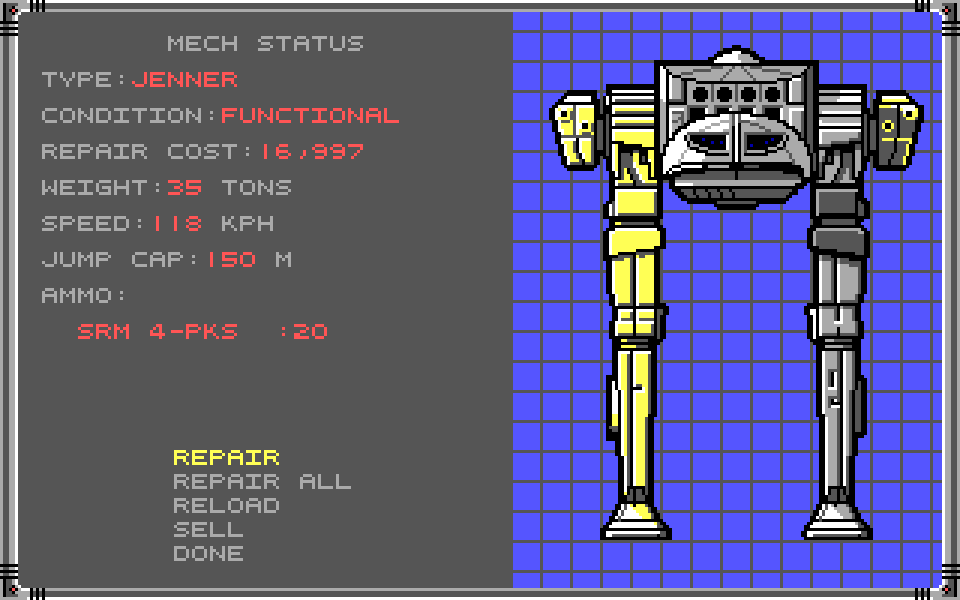
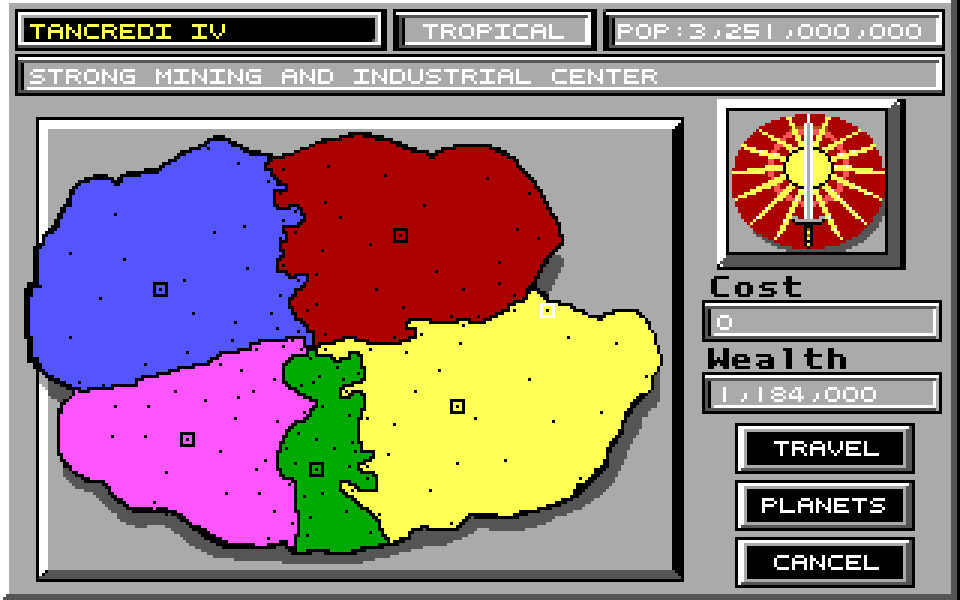
Discoveries
Rebuilding MechWarrior meant taking apart its programs, the campaign’s and the battles’, and comparing every step with the original. Here are all 26 findings, sorted by topic. Click a topic to open it.
Three programs, not one 3
- The campaign and the battles are two separate programs.
MW_MAIN.EXEruns the company: planets, the bar, the Mech complex, contracts and travel.BTECH.EXEruns a battle in 3D. A small launcher,MW.EXE, starts one, waits for it to end, and starts the other. Every time you deploy, the campaign program quits and the combat program starts from nothing; when the battle ends, it quits and the campaign starts again with the results. In 1989 that was how a game this size fitted in 640 KB of memory. - The campaign checks that the launcher started it. The launcher keeps an 11-byte block in its data (
MW.EXE0806:07D4), and the campaign tests three of those bytes as it starts (MW_MAIN081B:07D4, 07D8 and 07DE). Nothing ever reads the other eight. Likely this stopped players running the campaign program on its own. - Before every deployment the game looks for the combat program on disk. On floppies,
BTECH.EXEsat on a different disk from the campaign, so the game checked for it before each battle and asked for the disk if it wasn’t there. The rebuild drops those checks and the disk prompts.
The two releases 4
- The 1990 update to the campaign program changed only the copy protection. The 1989-11-03 and 1990-01-22 copies of
MW_MAIN.EXEare the same size and differ in 11 bytes, all in the copy-protection code (081B:174A..1782). Everything else, the whole of the campaign’s data included, is byte for byte the same. - The 1990 combat program is 266 bytes longer, and one fix shows. In combat’s two-line dialogs (such as the retreat question), the 1990 version waits for the key to be released, then clears the joystick buttons before going back to the cockpit (
BTECH0810:27F4 and 0810:29B2 in the 1990 build). The 1989 version waits for the key to change instead. Likely the fix stops the key that answers a dialog from also counting in the cockpit. The two versions’ battles run one tick apart in our recordings, so a recording made on one doesn’t match the other. - The copy protection showed a Mech picture and asked a question about it (
MW_MAIN081B:16A4..1819), before a new campaign starts. The rebuild leaves it out. It also drew random numbers, so leaving it out changes which random numbers the rest of the game sees. The rebuild’s test recordings were made again after it was taken out. - One copy has a Mech that can’t be loaded. In the 1989 copy we have, the Phoenix Hawk’s model file (
PHAPCK.TBL) has the right length, but from byte 0x1800 to 0x5FFF it holds the Marauder’s model file instead, plus one flipped bit at 0x166D. Any battle with a Phoenix Hawk stops. Whether other 1989 copies have the same damage isn’t known. The rebuild’s setup checks for it and names the file.
Mechs and the market 6
- The Wasp and the Wolverine were cut, but their stats are still there. The campaign has eleven kinds of unit: ten Mechs and the DropShip. Its tables give the Wasp 20 tons, 95 km/h, 180 m jumps and a price of 2,000, and the Wolverine 55 tons, 86 km/h, 150 m jumps and 4,966, with heat sinks, weapons and ammunition like the others. Both even have their names in the shop’s list. But when the market makes a Mech (
MW_MAIN081B:3BF7), a Wasp turns into a Locust and a Wolverine into a Phoenix Hawk, so you never see either. We haven’t found models for them in the game’s files. - That swap makes Locusts and Phoenix Hawks common. The market draws a light Mech from three kinds (Locust, Wasp, Jenner) and a medium from three (Phoenix Hawk, Shadow Hawk, Wolverine). With the swap, two of the three light draws come out as a Locust, and two of the three medium ones as a Phoenix Hawk.
- Every Mech for sale is used. The market rolls damage onto each one, in three passes from worst to light (081B:3BF7). The price comes down by what repairing it would cost. Your company’s first Jenner is damaged the same way, on purpose.
- Prices depend on the world, and you can make money moving Mechs. Each world has a market tier. A Mech costs its base price times 1.0, 1.2, 1.3 or 1.5 by the tier, and the dealer buys it back at 0.1 less: 0.9, 1.1, 1.2 or 1.4 (
MW_MAIN081B:4645 and the sale price beside it). Buy on a cheap world, sell on a dear one, and you keep up to 40%. On the dearer worlds the dealer only buys so many Mechs between restocks (the two dearest tiers). The rebuild keeps all of this as it was. - The DropShip’s price uses the last repair quote you saw. The price of any unit is worked out as its base price, minus the repair quote the game last calculated. For a Mech that’s its own damage. The DropShip has no damage, but the game still subtracts whatever quote is left over, so the DropShip costs less if you’ve just looked at a badly damaged Mech.
- Machine-gun ammunition is sold in batches of ten in the reserve-ammo shop, charged by the round; every other kind is sold one at a time.
The campaign 4
- Your company’s starting world is drawn at random from a list of eight when a new campaign begins (
MW_MAIN081B:166D on). - House Marik’s contract office always shows the same picture. Each House has a list of its worlds, split into groups, and the group of the world you’re on picks one of five regional pictures for the office. Marik’s list has no splits at all: one group of 19, with one world in it twice. So every Marik world shows the first picture, and the world’s second entry is never reached. It’s the game’s data as shipped.
- Travel uses a ready-made table of square roots. To turn the distance between two worlds into a travel time, the campaign looks up a square root in a table of 1,000 entries (
MW_MAIN1090:4CE6), entry *i* being the square root of 10 × *i*, rounded, and capped at 99. No formula we tried gives every entry. The best one matches 998 of the 1,000; entries 991 and 992 hold 98 where it gives 99. The rebuild computes the table and keeps those two as measured. - Some data is never used. There is a table of repair times by damage tier (
MW_MAIN1090:3A6F) that nothing reads, and a destination “time weight” for travel (1090:54DA) that is written but never read.
Combat 6
- Combat ran as fast as the PC could draw it. The combat program has no clock of its own: it does one step of the battle, draws the cockpit, and goes straight on to the next step. A step’s length came from how much the EGA card had to draw, about 14,000 bytes of screen a step. The port we started from modelled that, and its steps averaged about 127 milliseconds, under eight a second. On a faster PC the whole battle ran faster. The rebuild gives each step a fixed length, 60 ms by default, and lets you speed it up to 4×.
- Some waits did use real time. Dialogs, the flash when you lose, and the orders screen’s 76 ms minimum per frame are timed by the PC’s timer chip, and keep their real lengths.
- The radar reads the copyright notice when your lance has empty slots. With fewer than four Mechs in your lance, the heading radar (
T) still goes through all four slots, and for each empty one reads a “position” from address 0 plus 8 and 12 in the data segment. There, the original has the start of the Microsoft C runtime’s copyright notice. So it reads two pairs of letters as map coordinates, and plots a dot only if they happen to fall inside the radar. The port we started from stopped with an error here; it now reads those same bytes. - Combat has music drivers, but no music. The combat program has full drivers for the AdLib and for the Roland MT-32, but the game ships nothing for them to play in battle. Its sound file for combat holds only PC-speaker effects.
- The joystick was timed by counting. At every battle start, combat calibrates the joystick by counting how many game-port reads fit in a stretch of the timer chip. On a PC with no game port, every read fails and each axis waits out all 255 steps. In the port we started from, this took 0.83 seconds at every battle start. The rebuild reads joysticks through SDL instead.
- The parts of your own Mech are hidden. Your Mech exists in the 3D world like any other, but its torso, head, arms and legs are hidden, so you see from the cockpit without your own body in the way (
BTECH0810:25D4). A destroyed arm or leg is hidden the same way on other Mechs.
Music and sound 3
- The three campaign songs share one buffer. The bar song is loaded at the start of a buffer, the death song 9,000 bytes in, and the launch song 11,000 bytes in (
MW_MAIN081B:13A0..1422), and each load is allowed to read up to 64 KB. If the bar song were ever longer than 9,000 bytes, loading it would run into the death song’s place. The shipped files are short enough. - The MT-32 version uses the Roland’s built-in sounds. The songs never choose an instrument themselves. The MT-32 version picks the module’s preset timbres with SysEx messages, and the AdLib version sets its own 11-byte FM instruments. The rebuild plays the songs from a General MIDI soundfont, with each part given the nearest instrument to the MT-32’s.
- Combat’s AdLib instruments have a byte nobody reads. The combat program’s eight default AdLib instruments (
BTECH304E:2BA0) are 14 bytes each, but only the first 13 are used. The 14th is always zero.
With the addresses and details: the discoveries file on GitHub.