
Zipper Interactive and MicroProse, 1999. Rebuilt function by function from the original Mech3.exe (patch 1.2), most of it checked against the original running in an emulator. It plays the way it always did, minus the bugs and the problems it has on modern machines.
It runs natively on Windows 10 and 11, macOS and Linux: no Wine, no wrappers, no DDrawCompat. The original game files come with the install: the BattleTech launcher downloads them for you, CD music included, and this game offers the same download when started on its own and no copy is found. Or use your own copy: an installed 1.2 or 1.0, the original disc, or a disc image (.cue + .bin also gives you the music).
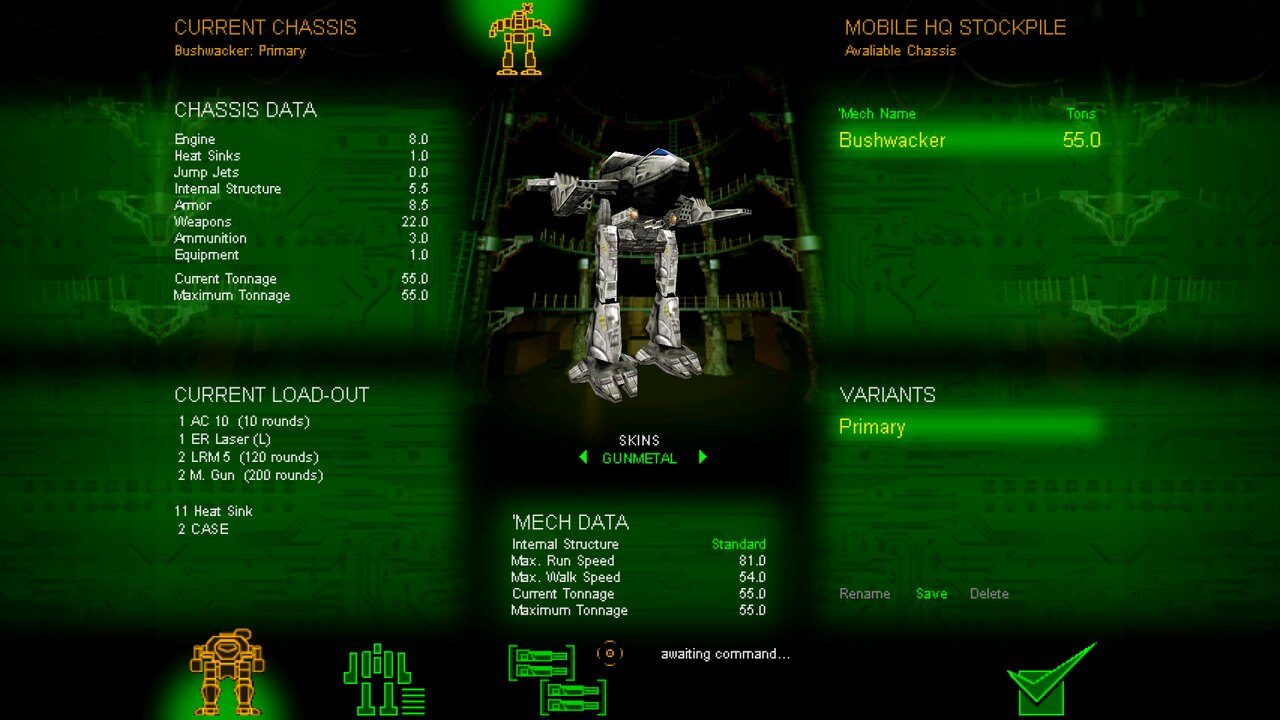
Screenshots
Discoveries
Rebuilding the game meant reading every function in its exe, and the exe had a lot to say: bugs, cut features, hidden rules and numbers nobody had seen. Here are 96 of the most interesting, sorted by topic. Click a topic to open it.
Heat 6
- Wading is a flat x8 cooling, however deep the water. The code divides the water depth by the mech’s height and squares the result, which looks like it was meant to cool more the deeper you stand. But it takes the larger of that ratio and 1, not the smaller, so the result is always at least 16 and gets capped at 8. Ankle-deep water cools as well as being neck-deep.
- Only the left foot counts. The water check reads the left foot alone. Wade in with just your right foot and you get no cooling.
- Hot missions cool you slower. Every mission sets an ambient temperature (
world.zrd), and heat sinks shed heat in proportion to 1 / temperature. At the default 20 degrees that is the usual rate; the 40-degree missions (c1, c4b mission 5) cool at half speed, t1 and c4 (about 31) about 1.5 times slower, and the cold c4b missions much faster: 10 degrees twice as fast, 2 degrees ten times. - Powering down triples your cooling. While shut down (heat shutdown or the power button), dissipation is x3.
- Lava ignores the frame rate. Standing on lava (either foot) adds 0.05 heat every frame, not every second. Everything else in the heat code scales with time. So the faster the game ran, the faster lava cooked you: about 1.5 heat a second at 30 fps, 3 at 60 fps. The game waits for the monitor’s refresh, so in 1999 that topped out around 60-85 fps; at 144 fps today it would be over 7 a second. The rebuild fixes it at 1.5 a second, what lava did at 30 fps.
- Overriding a shutdown is a dice roll. If you override the automatic shutdown and stay hot (above 0.9), the alarm starts and, every few seconds (a random 0.1 to 3, then 3 more), the game rolls. 80% of the time you get away with it, but each of those rolls may also cook off an ammo bin, the one with the least ammo x damage left, with an explosion sound. The other 20%, the torso’s damage routine runs and heat resets to zero (exactly what that does to the mech isn’t traced yet). At 2.0 there is no roll: the torso is destroyed. A mech that does shut down skips all of this and just waits to cool to 0.4.
Damage 9
- Lasers never cause criticals. Every laser is a beam weapon, and beams are excluded from the critical roll; PPCs, autocannons, missiles and Gauss can.
- Ammo criticals don’t explode. An ammo critical empties the smallest bin; no damage follows. CASE in the part blocks it.
- Difficulty is much kinder than it looks, and Hard is the real number. The exe has a fallback table (x0.7, x1.0, x1.3), but the game’s own
intensity.zrdreplaces it: you and your side take x0.4 on Low, x0.7 on Medium and x1.0 on High. So the numbers people quote for damage are High’s, and on Medium you take under three quarters of them. It doesn’t apply in multiplayer. The same file sets the AI’s aim error (x1.5, x1.2, x1.0) and how long it waits between actions (x0.3, x0.5, x1.0). The rebuild’s first releases missed the damage half, so every level played like High for damage. Your allies’ mechs likely get the same scaling (a team-mask test); enemies always take full damage. - Side torsos are hollow (from the code, not yet seen in play). Losing a side torso takes its arm, but the side torso itself is never treated as a lost part: weapons mounted in it keep firing, and heat sinks, jump jets and other equipment listed there keep working. Criticals on torso hits only look at what is listed in the center torso, so ammo and equipment in the side torsos can never be hit by a critical (only the overheat cook-off reaches side-torso ammo).
- CASE in a side torso does nothing. Since side-torso ammo can’t be hit by a critical anyway and the CASE check on torso hits only looks at the center torso, CASE is only useful in the center torso or an arm. The stock Mad Cat carries its two CASE in its side torsos.
- ECM makes you immune to NARC. A NARC hit sets a 30-second beacon, unless the target carries ECM (0x41ac10).
- XL engines have no damage rule. The
xlsetting changes only the engine’s weight in the mech lab; nothing in combat reads it. - A Blackhawk or Owens that loses a leg loses the arm on that side too. No other mech does.
- An AI mech remembers who hit it last forever. Only the player’s own mech forgets its attacker each frame, so an enemy that later dies from a fall, heat or its own ammo still gives the kill (and the salvage) to whoever hit it last.
Moving 5
- Walking into a vehicle hurts it, even a friendly one. A mech that bumps a vehicle damages it by the square of its speed: 20 points at full speed, 5 at half. It also shoves it, harder the heavier the mech. The game checks your team only for field bases. Every other vehicle, a convoy truck you escort included, takes the damage.
- Your throttle is not a speed, it picks a gait. Each mech’s file lists where its walk, trot and run start, as fractions of full throttle; the animation of that gait then carries the mech: its legs’ stride is its speed. Stand and step move nothing at all.
- Deep water almost stops a mech, and deeper water lets it go. Wading slows you once the water is a tenth of your height deep, to 70% shrinking towards nothing as the water nears the top of the mech. But once the water is deeper than the mech is tall the slowdown snaps back to a flat 70%. The shallower foot decides.
- Ramming hurts both mechs (code reading): damage grows with the square of your speed against your top speed, split by tonnage so the heavier mech takes less. Allies take none. Vehicles take 20 times more and are shoved, or crushed if that kills them.
- Weapon recoil twists your torso: a shot kicks the arm back and turns the torso, a left-arm weapon one way and a right-arm weapon the other (by the mech’s
recoil_twist). The kick fades in about a third of a second.
Weapons 12
- The plain PPC can’t be mounted.
weapons.zrddefines aPPC, but the MechLab’s weapon table (0x5e64f0) only lists the ER PPC, so no mech can carry the plain one. Its name is in the game’s text (message 0x2fd, right after the last weapon’s) and the slot it once had between NARC and the pulse lasers is empty: it was moved to the end of the list and its row was never added. The rebuild adds it, so the mech lab offers the PPC. - Hot lasers recharge slower. Above heat 0.5, a beam weapon’s recharge is multiplied by 0.5 / heat (0x4b43bf): at heat 1.0 lasers refill at half speed.
- Shots go where the reticle points, not along the arm. The reticle’s aim point is the first thing under it, and every weapon aims from its own muzzle at that point, so an arm laser crosses the reticle’s line on the way. Something in front of the aim point but off the reticle’s line, such as a mech’s leg below the reticle while the reticle is past its narrow torso, can take the shot. A held laser keeps following the reticle as the mech turns (0x4b41b0).
- CASE stops ammo crits but not heat cook-offs. CASE in a hit part cancels an ammo critical there (0x460e30), but the overheating cook-off roll never checks for it.
- Clan CASE weighs nothing and works.
equipment.zrdgives Clan CASE 0 tons and 0 critical slots (Inner Sphere: 0.5 and 1). The protection check only asks whether the part lists a CASE (0x460c10), not its slots, so zero-slot CASE protects like any other, and since equipment criticals are weighted by slots, it can never be destroyed by one. - Ultra ACs never jam: they simply fire twice as often as the standard AC (
FIRE_RATE1.0 against 0.5); nothing random in the firing code. - Lasers lose up to a quarter of their damage with distance, on a cosine curve: full damage up close, 75% at maximum range (
DAMAGE_AT_MAX_RANGE0.75, 0x583020). A short laser shot deals its damage once, to the first thing it touches. - LRMs inside 90 m do a quarter of the damage, and their splash radius shrinks to a quarter too (
RANGE_MINIMUM (90 0.25), 0x586402). - The FCS “double tracking” does nothing. Locking with FCS in the firing arm doubles a missile turn-rate setting, but the shot resets it before any missile reads it (0x58518a): each missile keeps its own copy of the 2, which nothing reads. What does work is the FCS missiles’ terrain following: low over the ground (under 10 m) they climb when the line to the target is blocked. The rebuild makes the double tracking work: FCS missiles turn twice as fast (and climb twice as hard), as intended.
- Missiles keep chasing a mech that dies. A locked missile follows a live point in its target’s body, and a destroyed mech stays in the world as a wreck, so a salvo in flight when its target dies flies on into the wreck as it falls (0x005a8630, 0x00585900). A missile fired with no target selected flies straight.
- Long straight shots can pass through the nearest wall. A cannon shot looks up every building along its whole range once, when it is fired, and then meets them in that list’s order. The list is not fully sorted (the sort does one pass: only the farthest is sure to be last), so with three or more buildings in the line, listed in the wrong order, the shot can fly through a nearer one to hit one behind it (0x585010, likely rare: it depends on the order the world lists them).
- TAG works, but almost never visibly. Checked frame by frame in the original code:
- Its beam lasts only a hair longer than the second it needs: 32 frames at 30 fps for 30 needed, and at 60 fps 62 for 61. At 30 fps you can slip off the target for one frame; at 60 fps or more, not once.
- Hold the trigger the whole time: letting go stops the beam, and the charge it used is gone. TAG only fires from a full charge, which takes 67 seconds at 30 fps (83 at 60), so a short tap leaves it dead for up to a minute with nothing to say why.
- The airstrike comes about 7 seconds later: the missiles start from a standstill 1.2 km or more behind you and speed up as they go. They fly to the spot the beam touched, not to the target, so a standing mech takes four direct hits (72 damage), one walking away at 18 kph only splash (about 58), and one moving faster than about 30 kph nothing.
- Ground and buildings that cannot be damaged never call it.
- On a fast PC the original’s TAG recharges slower, and above about 166 fps (or at 144 fps when running hot) it never recharges after its first use. The rebuild recharges it at its 30 fps pace at any frame rate.
- The rebuild keeps TAG hard but fair: the beam lasts what it did at 30 fps (1.07 s) and the hold is a true second at every frame rate, so you always have about 67 ms to spare, and the airstrike homes on the mech you marked. Flown by the original’s own missile code, all four hit a mech walking, crossing or running at 20 m/s.
The AI 8
- Keep shooting a friend and your whole side turns on you. If you keep hitting an allied mech for more than 3 seconds without a 3-second pause, every allied mech starts treating you as an enemy (though they stay “allies” to your targeting keys).
- The AI goes for whoever runs hottest. When an AI pilot picks what to shoot at, it weighs each target’s distance, how far it must turn, its health and its heat: the hotter a mech, the more attractive, and a mech past three quarters of the heat scale beats any cool one at any range. Vehicles and turrets never count as hot. Riding your heat high draws the enemy’s fire to you.
- Your lancemates shoot first, but never chase. An allied pilot picks its own target all the time: any enemy (or neutral) within its weapons’ reach, scored by distance, facing, damage and a clear line, whether or not anyone has attacked. What it never does on its own is walk toward a fight: every lancemate’s file has the “may engage” switch off, and none of your orders turns it on. “Attack my target” only makes it follow that enemy, and it still shoots whatever scores best, usually that one once it is the nearest. Being shot does not change any of this: a hit only gets you a radio line (a call for help when you are more than about 22 m away, “friendly fire” when it was you). Checked in the rebuild with Dominic in operation 1 mission 4: an enemy 60 m in front of him draws his fire at once; at 150 m behind a rise he aims and stands there, but on an open line he fires from 400 m and more.
- A pilot that cannot see you stands still. When its sight check fails and whoever is attacking it is out of range, an AI mech skips its whole update for the frame: it neither moves nor animates until something comes into sight (a cheap way to idle distant enemies).
- Enemies lead their shots. An AI pilot aims where its target will be when the shot arrives, from the target’s speed and its own, for every weapon but beams and instant-hit ones (those aim straight at it). On the ground a mech’s speed is judged from its throttle and facing, not from how it actually moves; in the air from its real velocity. Its torso then turns toward that point within its twist limits, and the shot waits until the torso faces it closely enough.
- Enemies never alpha strike. The AI was written to fire everything at once when its pilot rolls for it and the total heat fits, but a slip in the code (each weapon doubles a running total that starts at 0, instead of adding to it) means the totals never grow, so that choice never comes up. Instead an enemy nearly always fires a whole weapon group, any group that is in range and within its heat budget, and fires a single weapon only when no group qualifies. The hotter an enemy runs, the smaller its heat budget for a burst, and past about two thirds of its heat scale it holds fire altogether, even with weapons that make no heat.
- Passive radar doesn’t hide you from the AI. The radar mode key (Alt+R) cycles 1000 m, then 500 m “passive” when at the top, 500 m, 1000 m… Passive only stops your own Beagle and hides you from other passive radars; the AI never switches to passive, so it sees you as before. With C3 the cycle goes up to 2000 m, but the campaign caps the sensors at 1000 m anyway, so the extra range never shows.
- The Beagle Active Probe finds ambushes. Two in three of the campaign’s enemy mechs (106 of 168) start a mission powered down and wait for a script to wake them, usually as you come near. Until then they are on your radar but the target keys skip them. A mech with a BAP and its radar on active (not passive) can target them while they sleep, unless they carry ECM: you see the ambush and can shoot first. That is all the BAP does; it adds no range.
Missions and the campaign 8
- Two of c2 mission 3’s objectives are done before you start. The secondary objectives list Fireflies
firefly_01andfirefly_02, but the mission’s two Fireflies are namedfirefly_03andfirefly_04(the names of the earlier missions were reused). An objective whose target cannot be found counts as destroyed, so those two are ticked off at once. The rebuild points them at the right two. - Two in three campaign enemy mechs start the mission switched off. The vehicle file marks each mech that starts powered down (106 of the 168 AI mechs in the campaign and training missions), so they sit cold until the AI wakes them; most of operation 1’s do, while some later groups start up and moving (c2 mission 3, c4 mission 1, c4b mission 4). Dominic starts c1 mission 4 powered down too.
- The campaign starts underwater. In Operation 1’s first mission your Mad Cat stands on the seabed under almost 5 m of ocean and wades ashore.
- Three missions have minefields. Operation 1 mission 2 has 82 mines, operation 1 mission 4 194 and operation 2 mission 3 207; no other mission has any. A mine goes off when any mech comes within 20 m of it, measured in 3D: yours, your lancemates’ and the enemy’s alike, so an enemy walking through a minefield sets them off too, and jumping over one low enough counts. It fires the LANDMINE weapon (30 damage, a crater) into the ground under it, and its blast hurts everything within 40 m, falling off with distance, the mech that set it off included. A spent mine stays on the list but leaves the radar, which shows armed mines within 100 m as red X’s. Until the rebuild ported them no mine was ever loaded or checked, so these fields were harmless.
- One mission cannot be failed by leaving it. In mission 6 on the c4b world the player’s orders watch regions named
..._c4m7, but the mission ships them as..._c4bm6and..._c4bm7, so the trigger that fails you for leaving the mission area never fires, and the map likely shows no boundary there. The pair it meant is..._c4bm7: every mech of the mission starts inside it (the region files are numbered one mission ahead;..._c4bm6is two small unrelated areas). The rebuild reads it so, and leaving fails the mission. - Op 1 Mission 2 pays you for sparing the city. When you complete the “destroy the APCs” objective, each of ten city buildings (
citybuild01..citybuild011) whose intact model is still standing adds a little to the objective’s salvage: AC/10, LB-X, LRM and machine gun ammo, and three of them a Clan heat sink. A building already wrecked by then gives nothing. Op 4 Mission 1 does the same once: destroying the train adds a Mad Cat to the salvage if the partseg2tktis still active at that moment (what that part is in the world is not yet known). The salvage is decided at the moment the objective completes. - REPLAY on the pause menu is an instant mission failure. It does not restart anything by itself: it ends the mission as lost on the spot, without the “mission failed” voice, the red flash or the usual 8-second wait, and the end-of-mission screen follows, from where you replay. It only appears in a campaign or Instant Action, not in training or multiplayer.
- Why your lancemate gets stuck in the mission where you meet Epona Rhi. That mission has two floors in one place: the land on top, and a tunnel and works 45 to 90 m under it. The game tests only the “zones” the camera can see, and it uses the same list for a mech’s feet. So once you are in a different zone from your lancemate, the floor under him stops existing as far as his legs can tell. The only ground left is the land far over his head, which his legs read as a 45 m wall right in front of him, and the game kicks him backwards every frame, at full throttle, for as long as you stay away. He looks like he is walking into nothing. In the rebuild with bug fixes off (the original’s logic) he stood there for all 3 minutes of the test. The game knew the trick: several other checks turn the zones off first, just not this one. (Found from the code: 0x00476a30, 0x00477820, 0x0049e82b. The rebuild’s AI mechs read every zone.)
Mechs and the mech lab 7
- The Sunder’s Alternate B loses 240 LRM missiles to a typo: its file puts
extra (120 120)beside the LRM20’sammoinstead of inside it, so only the first 120 are loaded (checked in the emulator). - The Strider has no recoil slide because of a typo: its file says
recoil_slide ("1.5.0"), which is text, not a number, so the game keeps 0. Its neighbors (Cauldron, Bushwacker, Champion) have 1.5. - The Mad Cat gets half a ton for free. The loadout weight check takes 0.5 t off for the Mad Cat alone (0x425387), on top of the 0.24 t of slack every mech gets. Whether the mech lab’s own weight display does the same is not checked.
- Every mech’s weight includes a fixed 3 t cockpit plus engine shielding of 1 t per 100 rating, rounded up (a 300 engine adds 3 t).
- The Firefly has two WASP camos and no SLATE. Its fifth skin is labelled
MSG_SKIN_VARIANTDinstead ofVARIANTE, so both the fourth and fifth skins are named WASP; the second one uses the_e(Slate) textures. The data is certain; that the skin picker shows the name twice is not checked in game. - Mechs weigh nothing in your stockpile. The salvage screen’s “Current Tonnage” counts weapons, ammunition and equipment; a mech counts only against your bays, never against the 900 tons.
- The Vulture’s gun pods are not attached to it. Its two arm pods hang beside its body with a gap, joined to nothing; in play the distance and the motion hide it. Found while turning the mechs into 3D prints, where the pods need a strut to stay on.
Hidden and left behind 16
- A hidden fly camera is still in the game. Every mission makes an invisible “stealth” vehicle: no model, 10,000 health, up to 65 m/s, which hovers level a fixed height above the highest ground under it. A debug command puts the camera on it so you can fly around the level (and pan north-up in the overhead view), but no key in the released game can trigger it. The game only borrows it to hold the camera while your mech is swapped for another.
- There is a screenshot key nobody can press. The game has a command that saves the screen as a.bmp through a Save dialog (or, inside a multiplayer lobby, as
mw3_a12345.bmpand the like), but no key is ever bound to it in MW3 1.2. - The exe checks itself for stat hacks. The very first thing the game does is a CRC-32 over two tables built into
Mech3.exe: the mech roster (each mech’s name, tonnage and class) and the BattleTech internal-structure table (structure points by tonnage for head, torsos, arms and legs). If the result isn’t 0x00efd77d, someone has hex-edited the stats: the intro movies still play, but instead of the main menu the game goes to its “Exit State” and closes, with no error. Likely aimed at multiplayer cheats. - The well-known 1.2 NoCD exe is also a bug fix. Besides four jumps in the disc check, it stops a startup crash on fast PCs (a CPU speed test that divides by zero) and keeps a software-mode line from drawing outside the screen. Likely why some found it “more stable” than the original.
- Leave the main menu alone for a minute and the attract movie plays.
- Cheat and your MFD calls you DISHONORABLE. While the cheat mark is on, the multi-function display in the cockpit shows the word “DISHONORABLE” as its title; without a cheat that title is never drawn in single player. (In multiplayer the same spot can read “You are alone.”)
- The three hidden resolutions are real. The mode a mission starts in is the registry value
InGameVModeunderHKEY_CURRENT_USERSoftwareMicroProseMechWarrior 31.0. The menu offers 5, 6 and 7 (640×480, 800×600, 1024×768), but the game reads any number, and its mode switch also knows 8 (1152×864), 9 (1280×1024) and 10 (1600×1200). - A hidden fall camera. When your mech is knocked over, the game can switch the view to an outside camera for the fall and back when you’re up. Nothing in 1.2 turns that on. What happens instead: the cockpit view stops turning with the mech while it falls, and the torso swings back to center.
- MW3 ships an in-game editor named for another game. A debug command that no key is bound to opens “BATTLESPORT GAME EDITOR”. Why is a mystery: the BattleSport we can find (1996) is credited to Cyclone Studios, with its ports by Unexpected Development, not to Zipper. It is a mouse menu over the running mission with EDIT AI NETS, EDIT VEHICLES, EDIT WEAPONS (which does nothing in MW3) and EXIT GAME EDIT. The AI net editor has its own menu: go to a net, change a net’s or a node’s parameters, add a vehicle to a node, move or delete a node, a tree view, and Save Changes, which in the release saves nothing: the step that wrote the file is empty in the exe (read, not run), so an edit is gone with the mission. While it is open the camera rides an invisible vehicle, the “stealth” object every mission makes, and you fly it with the game’s own movement keys: throttle, turn and pitch, plus the mouse. It hovers at a fixed height over the ground like a sled, and a small readout names its movement mode (written into the debug text lines, which the release never shows). Your own mech is still driven by the same keys while you fly: hold throttle up and both move. And leaving the editor leaves the camera where the editor put it, on the invisible vehicle. Nothing in the released game can open it (the rebuild opens it for developers with Shift+F12 under –debug-camera and gives the view back on exit).
- Battlesport was Recoil. Recoil’s exes carry their source paths, and the game’s folder is
D:ProjBattlesport, beside the engine’sD:ProjGameZRecoil. So the “BATTLESPORT GAME EDITOR” in MW3 is most likely a name from Recoil, built alongside MW3 on the same engine and finished first, and not the 1996 BattleSport by Cyclone Studios (read from the exes’ strings; the two games’ overlap as a modder describes it). - Two dozen developer key commands sit behind the keyboard, none bound. Beside the editor, MW3’s key code still has the developers’ own commands, but nothing in the release binds a key to them: a frame-rate counter with the mech’s number readouts, a debug readout of the camera’s zones and of how many scene nodes, models, materials and live shots are in use, a speed control for the game’s lowest frame rate (five frames a second at a press), camera modes, “MIP Mapping Enabled / Disabled” and a mip bias for the software renderer, three zone-switching modes (“App Zone Switching Enabled”, “Camera Zone Switching Enabled”, “Zone Switching Disabled”), a key that hops the camera from mech to mech, a “Marker” that prints where the camera’s target stands, the teleport, the vehicle editor, the mech lab from inside a mission, and a “GameZ Interpreter” console that runs mission-script commands as you type them. One toggles a flag on your mech that nothing ever reads.
- A developer’s “haha” is still in the game. Each time an object named
blackhawk_01has its bounds rebuilt, the game prints “haha” (0x4ecc00), to a console a Windows game does not have, so nobody ever saw it. - Four movies the game’s scripts name were never shipped. fmv.zrd has entries for c3m3.avi and for an ending movie after each of the first three operations (c1win, c2win, c3win), but no copy of MechWarrior 3 has them: the US disc and the 1.0 and 1.2 installs hold the same 19 movies, byte for byte. Only the fourth operation’s ending (c4win) is ever played; c3m3 simply has no opening movie.
- The mech lab was built with three more tabs. Its code still handles WEAPONS, EQUIPMENT and MISSION DATA tabs (it hides the first two and MISSION DATA on every page and disables MISSION DATA as it opens), but the shipped dialog leaves all three out: weapons and equipment go on the CRITICALS page instead.
- The developers left their own teleport spots in every operation. Each world’s reader.zbd holds a location.zrd, the list a hidden teleport tool read (a debug command no key reaches in the release). The spots:
- c1: Mission 1 Start, Mission 2 Start, Mission 3 Start, IA_base;
- c2: Mission 1-3 Start, m1_dam, m3_dock, IA_base, m4_pipes;
- c3: m4_factories, m5_dome, m5_gateway, m6_spaceport, m3_dropship, m5_dock, IA_base;
- c4: m1_Train_station, m3_clan_base, m4_chateau, “personal trans trigger”, IA_base;
- c4b: dome, gate, batchall;
- t1 (training): Start Area, beach, town, road, mech_list, RoadEnd.
- 60 sounds were never shipped.
sounds.zrdnames 1058 sounds, but 60 WAVs are in neither archive: Dom’s four ejection lines, Alan’s fourth “disregard”, the wingmen’s acknowledgements (“sure sir”, “affirmative”, “right away sir”, “consider it done”, “I’m on it”, “no problem”) and taunts (“you’ll pay”, “yeah right”, “don’t take”, “not gonna”, “can’t do”, “goodbye”, “returning”), the “occupied” calls, the mech’s eject voice, and 36 lines of mission dialogue and one ambient loop. They simply stay silent. When a sound is missing from the archives, the game looks for it as a loose file in../data/common/sounds, a folder from the developers’ own source tree that no install has. So on the developers’ machines these files most likely played, and nobody noticed they were never packed into the archives. Whether all 60 were recorded is unknown (numbered names likege5310toge5315look like takes from a recording session). None are in the 1.0 or 1.2 install or in Pirate’s Moon, so every copy of the game has been silent there since 1999.
Graphics and the world 9
- Rain is not falling drops: it is new random streaks every frame. Each frame every raindrop is a fresh random point on the screen, and its streak is one frame’s motion as the camera sees it: the fall, the wind and your own movement against them. Walk forward and the streaks lean towards you; stand still in c4 and they fall nearly straight. Nothing carries over from one frame to the next, and a drop that would reach past the screen’s edge is simply not drawn.
- The software renderer draws with the stack pointer. To fill a row of pixels fast, it points the CPU’s stack at the screen and “pushes” colors onto it, two bytes at a time, backwards. It is quick on a Pentium, but anything else that uses the stack meanwhile writes straight into the picture. It is also why some modern wrappers (dgVoodoo) choke on the game.
- Every map has invisible mission boundaries. Flat red and yellow models under
inoutmark each mission variant’s in/out-of-bounds area. At mission load the AI reads the one it needs, then the whole set is deleted before the first frame, so nobody ever sees them. - The engine’s own fog is magenta. Before a world is loaded, the renderer’s built-in fog is on, bright magenta, from 500 to 700 m. It is the classic “you forgot to set this” color, and it never shows, because every world sets its own fog before anything is drawn.
- Past the edge of the map the ground goes on. The world’s grid of cells wraps around: look out beyond the edge and the game draws the terrain pieces again (only the terrain, none of the buildings) as if the map repeated.
- The original’s 3D view is about 8% narrower than it should be. The camera sees 80 degrees across and 60 up and down, but on a 4:3 screen that crams a little more width in than square pixels would hold: round things are drawn about 8% thinner than tall. Every player saw it this way, so the rebuild keeps it.
- The main menu’s “green ripples” are not drawn, they are the screen pushed around. Hovering a button starts a water ring that moves the pixels already there (the green background, other buttons) in and out along the radius by up to 7 pixels: three 12-pixel waves growing from the button’s center at 120 pixels a second, fading out in about half a second. The ring finds each pixel’s distance with a bit trick on the float instead of a square root.
- The intro and the ending movie are widescreen hiding in a 4:3 frame. INTRO.AVI is a 640×320 picture (2:1) with black bars baked in above and below; the ending (c4win) is mostly 640×240 (8:3, wider than a cinema screen), with a framed inset of about 568×283 partway through, and it switches to a full 4:3 picture for its last four seconds, the Mad Cat in a soft vignette. Every briefing movie is plain 4:3. On a widescreen monitor the rebuild shows the letterboxed parts across the whole width.
- Your cockpit glass cracks one mark per head hit, from six. Every cockpit carries three cracks and three dings, hidden until the head is hit. Each hit on the head shows one of the six, each about one time in six (the game draws a new random number for each of five tests: 16%, 20%, 25%, 33%, 50%, then the last). A crack also hides the whole pane under it and plays the cockpit crack sound at its spot; a ding just appears. The effect is one of the mission’s animations, aimed at a stand-in cockpit stored in every mission world until your mech’s own cockpit is built and takes it over.
Fast computers, old bugs 6
- The game clock went bad on machines left on for days. It reads Windows’ “milliseconds since the PC booted” into a 32-bit float. After about 4.7 hours of uptime the clock can only step in whole milliseconds, and after 10 days in 64 ms steps, so frames start to judder. A PC that sleeps instead of shutting down got there easily.
- Above about 150 fps the original’s turrets froze. Turrets ease their aim toward a target by e^-(3 x the frame time), looked up in a table that rounds down to steps of 1/51; on any frame shorter than 6.5 ms the lookup gives “don’t move”. Mech arms, recoil and vehicle turning use the same table and stall the same way. On 1999 machines it never mattered. The tripod missile platforms of Op 1 Mission 2 also start facing straight up, and the aim’s quick square root of 0 is not 0, so on such a fast frame a platform’s first aim squashed its launcher flat: still alive and targetable, but invisible, so the mission’s objective looked impossible. The rebuild eases by time and keeps a straight-up turret’s shape.
- The longer you played, the slower turrets got. Turrets take turns: each looks for a target, turns and fires only once every N frames, where N is the number of turrets the game has made since it started. That count was never reset, so every mission loaded or restarted (21 more turrets per Op 3 mission) made every later turret act less often. Each turn swings the gun only about a tenth of the remaining way, and it fires only when it points within about 27 degrees of you, so a turret facing away might never come round in time. The rebuild counts each mission’s turrets from zero.
- On a fast machine they fly. The suspension takes how far the ground rose since the last frame and turns it into speed, so the shorter the frame, the harder a small bump throws the vehicle. Above about 120 fps a small bump can roll an APC on its side. The game was built for slow frames; the rebuild caps that reaction at its 30 fps size, which calms most of it. (From the code, 0x004a2820, checked against the exe in an emulator.)
- On a fast computer the original never shows its mission messages: the message panel slides up 60 pixels a second, rounded down to whole pixels each frame, so above 60 frames a second it moves 0 pixels a frame and stays under the screen’s edge (at 30 fps it crawls at half speed). The rebuild carries the fraction: 60 pixels a second at any rate.
- Above 30 fps, jump jets could fail to lift you while walking uphill. The ground probes catch up with rising ground at a pace set for 30 fps; run faster and the catch-up overwrote the jets’ climb every frame, so the mech skimmed the ground with the jets roaring. Even a slight slope at walking speed did it, more often the higher the frame rate. Standing still, or at 30 fps or below, the jets always lifted. Fixed in the rebuild.
What the 1.2 patch changed 3
- Missiles hit 25% harder. LRM 5/10/15/20 went from 1, 2, 3.75 and 4 damage to 1.25, 2.5, 4.68 and 5. SRM 2/4 and Streak SRM 2/4 went from 1.2 to 1.5, and SRM 6 and Streak SRM 6 from 2.4 to 3. Missiles also knock harder (impact force up by half), and LRM 15 and 20 run cooler (0.075 to 0.0625 and 0.08 to 0.06 heat).
- Autocannons do less damage but shove harder. AC 5/10/20 (and the Ultra versions) dropped from 2, 4 and 8 to 1.625, 3.25 and 6.5; the AC 2 rose from 0.6 to 0.65. Their impact force went up, the AC 20’s from 0.7 to 1.75.
- LB-X autocannons fire half as often, with twice the spread. Every LB-X went from one shot a second to one every two seconds, its pellet cloud’s radius roughly doubled (LB 10-X 3.3 to 6, LB 20-X 5 to 8), and each pellet does about a quarter less damage (LB 10-X 1.67 to 1.25).
Controls 4
- Number key 2 sets 20% throttle, not the 10% the controls screen says. The keys give 0, 20, 30, 40.. 90 and 100%; there is no 10%. In reverse they give the same speeds backwards.
- Save your stick setup, unplug the stick, and the mech drives itself. The game only forgets the stick’s axes when your controls file exactly matches the defaults. Change anything about the throttle axis, even its dead zone, and with no stick attached the axis reads its resting value every frame, which opens the throttle (a slider on the twist or pitch swings the torso the same way). (From the code as ported: 0x00480570, 0x00427d60; not run on the original. Fixed in the rebuild with bug fixes on.)
- A joystick’s throttle can go in reverse: press Backspace. The throttle lever only runs from stop to full ahead, but “Toggle throttle direction” (Backspace, or joystick button 10) flips it: the same lever then drives the mech backwards, and Backspace again turns it round. And when you bind the throttle yourself with Assign Axis, wherever the lever sits when you press OK becomes stop: press OK with it in the middle and the lower half of its travel is reverse; at an end you get stop to full only. A lever on a slider (many throttles are) is not offered there at all. (Found from the code: 0x004274d0, 0x0042e5b0, 0x00430180. The rebuild’s lever covers reverse by itself.)
- Half of the cockpit’s voice lines are never played. The game loads 30 cockpit sounds at every mission start. It plays single, group and linked fire engaged, a critical hit, no ammo, ammo explosion, ammo jettisoned, coolant flushed, gyro overload, heat critical, MASC engaged and the two lock tones. “Damaged”, “destroyed”, the hit callouts for each body part, low ammo, coolant depleted, ECM engaged, friendly fire, gyro OK, targeting computer online and “traitor” are loaded, but nothing in version 1.2 ever plays them.
Multiplayer 3
- Your own PC decides whether your mech dies. Each player’s machine runs its own mech’s damage and death and tells the others. A hacked client could likely shrug off hits.
- In multiplayer an illegal loadout makes you invisible to the others. Each player’s mech is built on the other machines from the loadout they sent, and only if it passes the mech lab’s checks (weight, armor, jump jets, every item placed). One that fails builds nothing there: the player plays on, but no one else sees their mech.
- In multiplayer, ramming kills credit no one. Two mechs colliding hurt each other, and the push of another player’s mech is sent to you. The game meant to note who pushed you, but it notes the pusher as its own attacker, so if the push finishes you, nobody gets the kill. The rebuild, with bug fixes on, gives it to the pusher.
The full list has over 900 entries: the discoveries file on GitHub.